



Gardeners' notes compiled July 27:
July 20 - Harvested 30 lbs. of cucumbers. Harvested more squash.
July 22 - Harvested Yukon Gold potatoes with campers Lauren, Enni, Julia, and Stara.
Harvested and made Merc delivery: Yukon potatoes, squash, cucumbers, basil, tarragon, sage, cherry tomatoes.
July 23 - Pulled dead squash plants from row, freeing 1/3 of the row.
Staked and twined corn and gourds (removed one that looked like it was covered in a grey ash; Barbara thinks they were eggs).
Leaving flowers on opal basil; they are for flower arrangements, although edible, too.
July 24 - Harvested herbs with grades campers. Quinn and Max helped harvest squash, cucumbers, and Sun Gold cherry tomatoes.
Thursday, September 3, 2009
Garden Journal July 13, 2009-July 19, 2009
Gardeners' notes compiled July 19:
July 13 - Tied up tomatoes; harvested squash with two campers Lauren and Bella.
July 14 - Cut back basil.
July 15 - Harvested carrots (woody/starchy) with grades campers. Delivered squash order to The Merc.
July 19 - What amazing weather! Enjoying the temperatures, although they do make one a little unsettled...low 50's in July in Kansas...what's next?!


Tuesday, September 1, 2009
First Kansas Green School in Douglas County


On July 15, a final report was submitted for the Kansas Green Schools Water Quality Grant awarded earlier by Kansas Association of Conservation and Environmental Education (KACEE) and the Kansas Department of Health and Environment. This grant advanced Prairie Moon Waldorf School, the first Kansas Green School in Douglas County, as a leading environmental school in northeast Kansas. Three major goals were fulfilled through the grant: (1) to develop a Prairie Moon Nature Curriculum, including a garden curriculum, which will teach about non-point source pollution; (2) to offer a 2009 Prairie Moon Water summer session, including instruction about water quality and water conservation; and (3) to constuct a rain barrel system for watering the Okanis Garden and other beds and plants on the school grounds.
For (3) above, it was determined to construct a rain tank system, consisting of two 425-gallon farm tanks, elevated on cinder blocks.
Garden Journal June 3, 2009-July 7, 2009
Gardeners' notes compiled July 10:
June 3 - Mulched basil and peppers. Watered seeds.
June 5 - Foliar-fed entire garden with fish emulsion.
June 6 - Cucumbers up, pole beans have grown considerably.
June 8 - Carrots in tomato rows germinated. More corn and gourds in north row up. Fed Barbara’s compost to tomatoes. Planted EZ Pick snap beans near corn.
Planted borage seeds in gourd/bean row.
Flushed irrigation lines to remove calcium and mineral deposits.
June 14 - Squash blossoms! Several on many plants. Potatoes with lots of blossoms. More rain and thunderstorms in the schedule...as well as above and below average temps. How's that for Kansas weather? Let's just keep our fingers crossed we don't get hail!
June 15 - Yellow crookneck squash developing.
Foliar-fed.
Took soil sample from tomato row. Delivered sample to Douglas County Extension Agent Jennifer Smith: There are four forms of nitrogen in the soil. Extension office tests for two; they make recommendations for fertilizing and provide no N numbers. Jennifer said that next year, add compost before planting. Potassium is only an issue at 800-900. Tomatoes likely were struggling with the weather.
June 17- Weeded and mulched one tomato row.
(One day this week, early childhood class toured garden and planted radishes in cucumber row.)
June 22 - Weeded cucumber bed, top-dressed with compost.
Squash ready!
Watered overnight.
June 24 - Harvested squash, delivered to Sula at the Merc.
First cosmo blooms! Some zinnias budding.
First row of tomatoes have blossoms.
Aphids on one squash blossom. One limb of a squash plant was dead, found a break, suspect vine borer.
Cucumber being eaten by cucumber beetle (yellow and black stripes found on many plants).
Heavy weeding and mulching.
Tied horizontal twine for pole beans.
Soil very wet under mulch over potato plants.
June 27 - Weeded, mulched.
June 29 - Posted wooded garden signs made by students.
July 1 - Teachers and summer students harvested squash.
July 3 - Harvested more squash, added to July 1 harvest. Heavily harvested basil.
Several squash are diseased. Plants have yellowing leaves and rotting fruit. Yellow crookneck are developing a black and fuzzy mold. Green striped squash is turning yellow.
July 5 - Just got back from the garden and it is looking pretty green and growing there. Saw one Louisville Slugger (zucchini)...they just jump to that size when you turn your back.
July 6 - Led cucumbers up trellis. Added vertical twine for yard long pole beans.
Wrapped plants around corn; some gourd plants are too heavy.
Some carrots in leek/oinion row are mature enough to harvest.
Cultivated and mulched pole beans.
Mulched zinnias.
July 7- Early childhood class harvested squash. Another squash plant is dead--the one closest to the one earlier removed due to signs of borer.
Foliar-fed everything except squash and the herbs soon to be harvested.
Harvested cullinary sage and Mexican tarrigon.
Made second delivery to The Merc–squash, tarragon, sage.
Precious Soils and Water


For the Japanese guests who visited Prairie Moon on June 29, Douglas County Extension Agent Jennifer Smith gave a great presentation on soils and water.
Using an apple as an analogy for the earth, Jennifer addressed how little soil there is on the planet that is suitable for growing food. She cut up an apple, representing different parts of the earth. One thin apple sliver represents the soils where food can be produced. Capability Class #1 soils equal 2.8% of all the soils in Douglas County; Capability Class #2 soils equal 8.2%, for a total of 11%, which can be grown on, with no limitation. Capability Class #3 through #8 represent increasingly limited capabilities.
The soils of the grounds of the Prairie Moon Waldorf School are Capability Class #1–among the most precious 3%. The top soil of the Class #1 soils around Prairie Moon is said to measure up to 90”. Jennifer Smith easily pushed a coring tool into the ground, drawing up a plug of top soil which far exceeded the measurement of the tool.
One gallon of water represents all the water on earth. One-half to one cup of water out of the gallon represents all the fresh water on earth. The rest of the water is salt water. Only one drop of that cup is available for use; the rest of the cup is deep groundwater or in the soil and air. With only the one drop, there is an urgent need to protect it and keep it pure. No new water is being formed or made–it cycles over and over.
Global Partners to PMWS


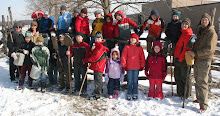
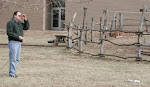
On June 29, the Okanis Garden was honored to welcome a delegation of Japanese organic farmers from Global Partners for Local Organic Foods (see previous blog post). Also visiting the garden that day were: (Bottom Picture) Downtown Lawrence Farmers’ Market Coordinator Tom Buller, third from left, and Elizabeth Schultz, far right; and (Top Picture) Douglas County Community Foundation (DCCF) Executive Director Chip Blaser, standing. Elizabeth Schultz established the Elizabeth Schultz Environmental Fund (ESEF) through the DCCF; an ESEF grant was gratefully received by Prairie Moon Waldorf School to develop the Okanis Garden, first plowed in March, 2009.
Prairie Moon summer camp instructor Ms. Lana and her students serenaded the Japanese visitors with the garden song, “Inch by Inch."
Japanese-Kansas Exchange
Jeffrey R. Severin, Director of the KU Center for Sustainability wrote the following article for The Oread, the faculty/staff newspaper of the University of Kansas. The article mentions the June 29, 2009, visit by Japanese organic farmers to the Okanis Garden at Prairie Moon Waldorf School.
July 13, 2009
Sustainability spotlight
US-Japanese exchange focuses on organic agriculture
Local and organic food systems were in the spotlight last month as a 10-member Japanese delegation of organic farmers and sustainability activists visited the Lawrence area. The delegation was here as part of Global Partners for Local Organic Foods, an exchange project with a mission to address the decline of rural communities and local food production and establish closer personal relationships between food producers and consumers. The project brings together the Japanese delegation with a similar team from Lawrence.
Patricia Graham, Research Associate with the Center for East Asian Studies, conceived the project and co-directs the program with Kansas Rural Center Director Dan Nagengast.
“The goal is to get more people interested in locally produced organic food,” she said, “and to realize that the local organic food industry is a viable professional career path. We want more organic growers, we want more restaurants to use local organic food, and we want more grocery stores to carry local organic products.”
As part of that effort, the Japanese delegation visited organic farms in Lawrence and gardens at the Prairie Moon Waldorf School; toured Central Soyfoods, a local organic tofu producer, and the Bowersock hydro-power plant; and put on a cooking demonstration at the Lawrence Farmer’s Market. At a stop at Johnson County Community College, they learned about that college's sustainable agriculture program, campus-wide sustainability initiative, and the JCCC food service program that uses vegetables grown by students at the Kansas State University's Horticulture Center. On a trip to the Flint Hills they saw a rain water collection system, a passive solar installation, and wind turbines. The group also dined at organic restaurants in Lawrence and Kansas City and presented information at a public forum at the Lawrence Union Pacific Depot.
The tour was the second half of an exchange with team members in Lawrence. The Kansas delegation traveled to Japan in May where they learned about traditional farmhouse preservation, toured organic farms, and spent time in a community that has a strong focus on organic farming. The group saw many examples of sustainability in the food system including farmer training programs, a school lunch program that uses locally grown organic food, businesses that partner with farms to incorporate organic produce, and the conversion of food waste into biogas and liquid fertilizers.
The Kansas delegation also visited urban farms in Tokyo, which tied into the research interests of Lawrence team member and Eric Rath, associate professor of history. Rath is currently completing two books about Japanese food.
“The strength of this project was regular folk beyond just academics. The project included farmers, people involved in organic agriculture and urban farming at various levels, agricultural extension agents, restauranteurs, the Kansas Rural Center and others. These people have the potential to make real changes beyond just sharing ideas, and it was exciting to work with them,” Rath said.
The idea for the project grew out of a program Graham was involved with at KU from 2002-2006. Through the Kansas Asia Scholars Japan Program, Graham took students from KU to study sustainability in Japan. The program highlighted cultural and natural resources of Japan and included meetings with the nonprofit organization Japan For Sustainability. KU students presented information on aspects of sustainability at KU, in Lawrence, and across the United States and learned about sustainability from their Japanese counterparts.
Global Partners for Local Organic Foods is funded through a grant from the Japan Foundation Center for Global Partnership. Supplemental funding for Kansas projects and the group's Web site came from the Elizabeth Schultz Environmental Fund of the Douglas County Community Foundation, established by KU emeritus professor Elizabeth Schultz. For more information about Global Partners for Local Organic Foods, visit www.gplof.org.�
Subscribe to:
Posts (Atom)